Posts tagged as "decimals"
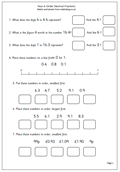
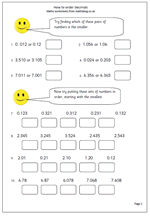
Year 4 maths worksheet on ordering decimal fractions
One of the most important concepts in maths is to understand that the value of a digit depends on its place in the number – otherwise we could only possibly have 9 numbers and zero! So the digit 2 in 120 has a different value than the 2 in 210. The 2 in 120 has [...]
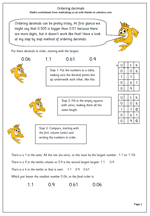
More help with ordering decimals
I have published worksheets on ordering decimals before, but this page, lent to me from urbrainy.com is a very neat way of making sure that decimals are put in order correctly. It suggests a very simple, step by step, approach which includes: 1. putting the numbers underneath each other, in a table, making sure that [...]
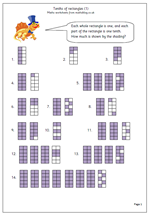
Year 4 decimals
One of the best ways to introduce decimals is by working with money which shows the idea of tenths (10p) and hundredths (1p). Another good way is to use shading of shapes and this is the second page which does this. A series of rectangles is shown, each divided into ten equal parts: each part [...]
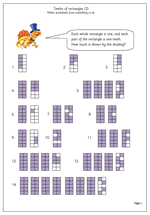
Year 4 maths worksheet: Tenths of rectangles
A good way of working with decimals is to use shapes which are divided into ten equal parts. The shape is one whole unit and each part is one tenth, which can be written as 0.1. This page has a selection of shapes and asks the child to write down the amount that has been [...]
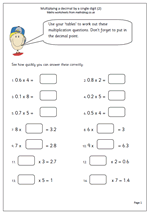
Multiply a decimal by a single digit (2)
Here we have two more pages of practice at multiplying a decimal by a single digit. The first six questions on each page are straightforward enough but the later questions may prove to be trickier. For example: 8 x ? = 3.2 could appear to be quite difficult to work out. Because 3.2 is a [...]
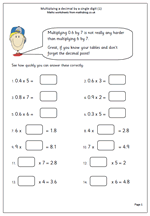
Multiplying a decimal by a single digit
Some quick mental arithmetic work here, ideal for homework. Multiplying 0.6 by 7 is not really any harder than multiplying 6 by 7, as long as you have a good understanding of place value. Watch out for a common error with these, an example of which is: 0.8 x 7 = 0.56 In this case, [...]
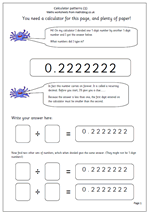
Year 6 maths worksheet: Calculator patterns and recurring decimals
The calculator can prove to be a great tool for those who are fascinated by numbers and these pages give us just one example of this. It uses simple division sums to produce interesting recurring decimals. For example: 1/9 is 0.111111 2/9 is 0.22222 3/9 is 0.33333 and so on. It also asks children to [...]
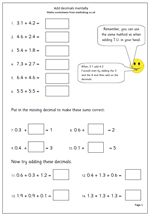
Year 6 worksheet: Add decimals mentally
A straightforward mental arithmetic page on adding decimals. The process is very much the same as adding two 2-digit whole numbers. When adding in our heads we usually start with the largest numbers, which, of course, is the opposite of the way we do it on paper. This needs pointing out to children as many, [...]
Year 6 maths worksheet: How to order decimals
This week I am slightly reorganising the way that pages are being organised. I have had a lot of requests from teachers asking if resources can be organised in terms of the Block and Unit Planning required by the Primary Framework for Teaching. I have decided to start with Year 6 and with ordering decimals. [...]
Resource of the Week: Decimals that make 10
Here we have mental arithmetic maths worksheet on decimals, most suitable for Year 5. This page looks at pairs of decimals that make 10. Once again there are several ways of tackling these questions. One way is to add on from the smaller number, firstly, the tenths to make the next whole number, and then [...]
- Privacy Policy
- © 2009 Maths Blog