Maths from stories
Handa’s Surprise by Eileen Browne
Handa’s Surprise (Walker paperbacks)
Handa’s Surprise is a great book for young children – one that they really like to have read to them again and again. As well as being a good story it incorporates some strong maths concepts, including counting, sequencing and subtraction.
Set in Africa there is a warm summery glow to the book with bright illustrations and a range of unusual animals and fruits which children may not have come across before.
Handa puts seven exotic fruits into her basket and sets off to take them to her friend. She carries the basket on her head and as she walks along animals steal the fruits one at a time.
This is available as a ‘Big Book’ and with a DVD.
Handa’s Surprise (Walker paperbacks)
The Shopping Basket by John Burningham

The Shopping Basket (Red Fox picture book)
The Shopping Basket by John Burningham is a great little book which will be thoroughly enjoyed by young children whilst at the same time helping them with counting and subtraction. Steven is a little boy who is asked by his mum to go round to the local corner shop, taking the shopping basket with him to bring back 6 eggs, five bananas, four apples….etc. The scenario will be familiar to many children as a trip round to the corner shop is often the first time they are allowed out alone by their parents. However, this is not an ordinary trip to the shops as Steven meets all kinds of dangers on the way. These dangers come in the form of animals such as a bear, a monkey and a kangaroo, demanding the contents of his shopping basket. Steven deals with the dangers in a variety of ways and arrives home safely – but will his heroic efforts be appreciated? John Burningham is one of the best writers of children’s books and this is one of his best – humourous, well illustrated and not to be missed.
Billy’s Beetle by Mike Inkpen
Billy’s Beetle is another of Mike Inkpen’s great books for young children. Little Billy’s beetle escapes from its matchbox leading to a hunt to find the missing beetle. Billy seeks help from a variety of people and animals to try and find it. First of all he gets help from a girl and then a dog. The dog finds a hedgehog, spiders and worms but not his beetle. As the hunt goes on other creatures get involved, including a polar bear and an elephant. Look out for a hidden beetle on each page! Great illustrations and brilliant for reading aloud; you might find that you will have to read it time after time! It also helps with beginning to understand the language of addition and subtraction.
Mr Wolf’s Week by Colin Hawkins
Mr.Wolf’s Week
Mr Wolf’s Week by Colin Hawkins is an old favourite and one of the best versions is the mini-pop up.
In this book the wolf is not very threatening, perhaps almost friendly in appearance. It is a brightly coloured book which leads you through a week in the life of Mr Wolf. He wears different clothes each day of the week which co-incide with the type of weather. It rains on Mondays so he takes an umbrella with him etc etc. The pages are really brightly coloured and funny.
Good for talking about the days of the week in the right sequence as well as talking about the weather.
There is not a lot of writing on the pages, but the illustrations give plenty of ideas to talk about, which is probably why it is a favourite in classrooms.
The Enormous Crocodile by Roald Dahl
The Enormous Crocodile
review by mathsblog.co.uk
The Enormous Crocodile by R Dahl
If you want to introduce your child to some mathematical words involving shape and have enormous fun whilst doing so, then ‘The Enormous Crocodile’ by Roald Dahl is just the book for you. But you do have to have a delicious liking for cruel humour and not mind rather tasteless endings!
Typical of Dahl’s writing, with name calling, suspense and a horribly vile villain, it is probably best left for the over threes. You might find that your children become horribly addicted to the story and want it read to them time and again!
In short, the crocodile tells the other animals that he has some clever tricks up his sleeve to eat some juicy children. Indeed they are clever tricks, but one by one the hippo, monkey etc ensure that his plans are thwarted and the greedy croc comes to a suitable end!
Teddybears Go Shopping by S Gretz and A Sage
Teddybears Go Shopping (Picture Hippo)
Storybooks that are great for maths from mathsblog.co.uk
Making lists is an important part of the data handling strand of the Primary Framework for Maths and there is hardly a better example of list making than Teddybears Go Shopping by Susanna Gretz and Alison Sage.
The shopping list is very much like a song and encourages children to repeat it –great for encouraging the memory! However, all does not go exactly to plan at the supermarket as William and the rest of the bears go shopping!
Children of all ages love this book – well worth reading!
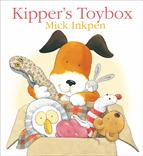
Kipper’s Toybox by Mick Inkpen
Kipper’s Toybox (Kipper)
If you are looking for a great book to help with early counting then Kipper’s Toybox is a must.
Kipper is a cheeky little puppy who is concerned that somebody or something is nibbling a hole in his toybox and that his toys might not be safe. But, the trouble is, that every time he counts them he gets a different number. To make it easier to count he lines them up.
Then, one night, one of his toys appears to have come to life!
Colourful illustrations and a great story line makes this a fabulous book for all 3+ children.
It could also be used as the basis of a great counting activity at home. Use a box with 5 toys, count them as you put them in. Take one away, count them again and see if your child can spot which one is missing.
Jim and the Beanstalk by Raymond Briggs
Jim and the Beanstalk (Puffin Picture Books)This is a rewrite of the famous Jack tale by Raymond Briggs. Just like Jack, Jim wakes up to find a tall plant growing outside his house. He climbs up to the top where there is a huge house. A very old giant lives in the house – not the nasty sort of giant in the traditional tale, but an unhappy one who no longer eats three boys on toast for breakfast! Jim gets the giant some large glasses, giant false teeth and a very red wig!
The ending is lovely and there is some great mathematical language in this book, mainly to do with size and shape. Perfect for 3 to 5 years old.
Why not take your child through an imaginary climb up the beanstalk to meet the giant?
Seven Dizzy Dragons and Other Maths Rhymes by Sue Atkinson
‘Big books’ tend to be used only in schools as they are great for a teacher to sit with the class and look at the story. They also tend to be quite expensive and not easily available in book shops. This great book can be purchased as a ‘Big Book’ or as a paperback, but it is not easy to find.
However, I have put ‘Seven Dizzy Dragons and Other Maths Rhymes’ in my collection as it really is a great set of rhymes.
It contains 28 counting and number rhymes, including counting up in ones, twos, threes, and so on, odd and even numbers, patterns of numbers, ordinal numbers, number bonds to ten, and early addition and subtraction.
There are lots of ways to enjoy this book including learning and reciting the rhymes together and it is a great resource to help with early counting and number.
Two by Two by Barbara Reid
This book is a real must for any parent who loves sitting down and looking at books with their young children. Written in rhymes to tell the story of Noah’s Ark you will find your child returning again and again to their favourite pages.
One of the best aspects of the book is the amazing 3-D sculptured animals, but the book can be enjoyed in a number of ways. The rhymes can be read or sung and children can soon learn them or just look at the animals and talk about them and the tricks they get up to.
The animals come in two by two, three by three, four by four etc so it is easy to incorporate a little maths.
The Cockatoos by Quentin Blake
Cockatoos (Red Fox Picture Books)Another great book from Quentin Blake which will help children with their counting. The star of the book is a very fuddy duddy old chap called Professor Dupont. His day never changes; every morning washing, dressing, putting on his tie, going downstairs etc etc he sticks to the same routine which includes welcoming his ten cockatoos with exactly the same phrase every day,
“Good morning, my fine feathered friends!”
Now, the cockatoos are very, very bored with this routine and one day decide to play a trick on Professor Dupont. When he opens the conservatory doors to say good morning they have all gone!
The rest of the book is for the reader to find each of them, because the Prof just cannot find them.
Of course there is a happy ending. Some parents might themselves find this a little tedious but in my experience children (2 – 5) certainly don’t, so if you haven’t already, sit down and read it with them.
The Doorbell Rang by Pat Hutchins
The Doorbell Rang by Pat Hutchins.
A great writer of children’s picture books, Pat Hutchins has created a wonderfully simple book which helps with the very earliest understanding of sharing. Mum has made 12 scrumptious cookies for her two children – obviously they are going to get lots each. They count them and find that they are going to get six each but then the doorbell rings and friends arrive to share the cookies. Each time the doorbell rings there is less for each child until they are down to only one each. Then the doorbell rings again!!
-
Blogroll
Resources
-
Tags
5 times table add addition Add new tag bar chart bodmas calculator calculators counting decimal fractions decimals division doubling estimating fractions Free maths worksheets handling data investigation Maths Games maths stories measure measurement money multiples multiplication multiply negative numbers number percentage pictogram place value puzzle puzzles ratio rounding shape sharing space learning square numbers subtract subtraction tables time times tables written methods of subtraction
WP Cumulus Flash tag cloud by Roy Tanck and Luke Morton requires Flash Player 9 or better.
Archives
- September 2010
- August 2010
- July 2010
- June 2010
- May 2010
- April 2010
- March 2010
- February 2010
- January 2010
- December 2009
- November 2009
- October 2009
- September 2009
- August 2009
- July 2009
- June 2009
- May 2009
- April 2009
- March 2009
- February 2009
- January 2009
- December 2008
- November 2008
- October 2008
- September 2008
- August 2008
- July 2008
- June 2008
- May 2008
- April 2008
- March 2008
- February 2008
- January 2008
- December 2007
- November 2007
- October 2007
- September 2007
- August 2007
- July 2007
- June 2007
- © 2009 Maths Blog
- Privacy Policy