Archives for "June, 2011"
Resource of the Week: Reflective symmetry
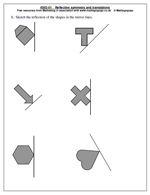
There is quite a lot of work done in Year 6 on symmetry and the subject often comes up in the Key Stage 2 SATs. Some of this involves important vocabulary and by the end of year 6 children should know and be able to read, write and use the following quite tricky words: Mirror [...]
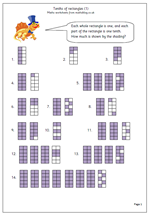
Year 4 maths worksheet: Tenths of rectangles
A good way of working with decimals is to use shapes which are divided into ten equal parts. The shape is one whole unit and each part is one tenth, which can be written as 0.1. This page has a selection of shapes and asks the child to write down the amount that has been [...]
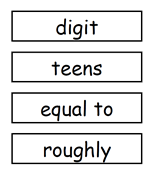
Year 1 maths vocabulary
If a child does not respond to a mathematical question it may be because they do not understand the words or instructions used. Another difficulty can arise when a mathematical term has a different meaning in everyday English eg ‘table’. In the Year 1 maths category there is an excellent list of the vocabulary children [...]
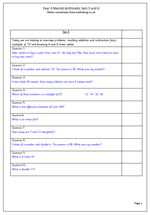
Year 3 Mental Arithmetic: Sets 5 and 6
This week I have published the next two sets of mental arithmetic questions for Year 3. They concentrate on one-step problems, recalling addition and subtraction facts up to 20,adding and subtracting multiples of ten and knowing 5 and 4 times tables. There are several ways these questions can be used and how children answer them. [...]
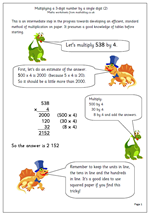
Year 5 maths: Written multiplication
Here we have a second page of questions which are an intermediate step in the progress towards developing an efficient, standard written method of multiplication. It presumes a good knowledge of tables before starting. This method breaks the task down into four parts. For example: when multiplying 538 by 4, the four parts are: 1. [...]
Maths Resources: Written Addition
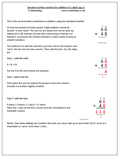
One of the most popular parts of the site for parents is our Free Maths Worksheets: Four Rules pages on written addition. Many parents think that the methods they were taught at school (and for many this would be in the mid 1990s) are different from today. This is only partly true. Since the onset [...]
Year 6 Maths Worksheet: Equivalent fractions
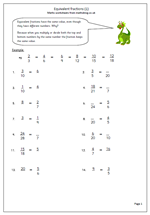
Understanding equivalent fractions is at the heart of understanding how fractions work. Much work needs to be done in earlier years to show that fractions such as 1/2 and 2/4 have the same value. This is usually done by colouring or shading parts of rectangles, circles. Two fractions which are equal in value we say [...]
Year 4 worksheets: Division with remainders
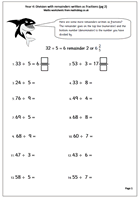
Division nearly always requires carrying out more than one process, which makes it harder for children to process. A good knowledge of tables is also needed to complete division questions successfully, and this is especially true when there are remainders. For example: to find the answer to 37 divided by 5: ask how many fives [...]
Year 3 Mental Arithmetic Sets 3 and 4
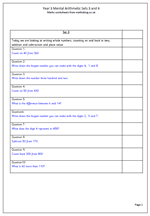
Two sets of mental arithmetic questions suitable for Year 2. These sets of 10 questions cover counting on and back in tens, addition, subtraction and place value. I have been asked for more in the way of mental arithmetic questions on many occasions and as the weeks go by this should build into a really [...]
Maths worksheets: Division of money
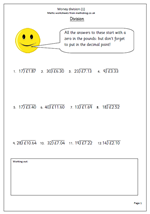
There are not many questions on this maths worksheet but they are quite tricky and a good knowledge of tables and how to do long division is needed. Each question has an amount of money to be divided by a 1 or 2-digit number. In all cases the answer wil have a zero in the [...]
- Privacy Policy
- © 2009 Maths Blog